Is a half niqab enough?
The answer given here is no: what is called half niqab is really a lithām, and it leaves the forehead uncovered. But reports from the early generations do allow the brow area, so the answer is narrower than it first appears.
Generated with NotebookLM to help understanding. May contain unintended errors.
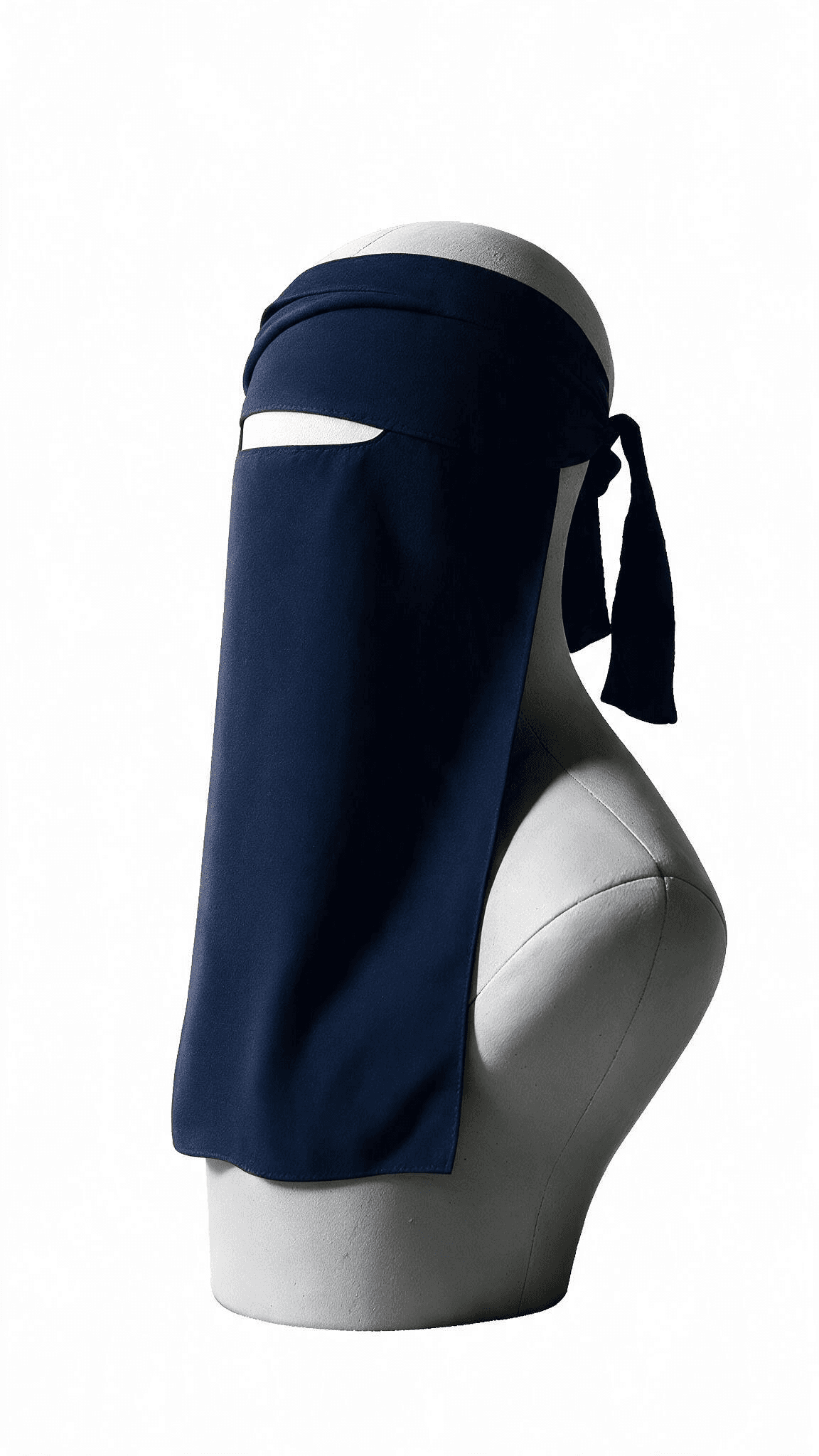
What a niqab covers
In its original form the niqab exposes the eyes and the area immediately around them — the maḥjir — and nothing else.
What is marketed as a half niqab is not, on this reading, a niqab at all but a lithām: a covering of the lower face. Some contemporary scholars judge it insufficient because it leaves the forehead exposed, and the concession in the garment was never for the forehead.
The complication this page raises against itself
Because the brow falls outside the technical definition of maḥjir, the default position is that it, too, should be covered. That argument is immediately complicated by evidence pointing the other way.
Qatādah's report has the covering drawn above the brow, which implies the brow itself may be left visible.
God commanded them to draw the covering above the brow when they go out.
The athar of ʿAbīdah al-Salmānī points the same way. Ibnu Sīrīn describes him letting the ridāʾ down from above until it came close to the brow, or above it, and this stands only as a possibility that the jilbāb need not cover the brow, not as a demonstration that it need not.
Al-Naḥḥās (d. 338 H) transmits from al-Ḥasan al-Baṣrī that the verse's phrase means covering half the face, though the chain for this report is not supplied and could not be located, which is a real limitation on that report.
And Ibnu al-ʿAṭṭār, of the Shāfiʿī school, permits the forehead to be exposed: a Muslim woman's face, he states, should not be left uncovered beyond about the width of the fingers from the top of the face.
Where that leaves the answer
The strict reading — that a half niqab is insufficient — is the stated position here, asserted plainly. But it sits alongside early reports and at least one Shāfiʿī authority permitting the brow, or at most a finger's width beyond it.
So the honest answer is: on the strict reading, no. On other reported views, possibly — but only for the brow, not more. What is sold today as "half niqab" does not stop at the brow; it leaves much of the upper face open, well beyond what even the permissive reports allow.
Check your understanding
On this note's stated position, what is the main problem with what is marketed today as a 'half niqab'?